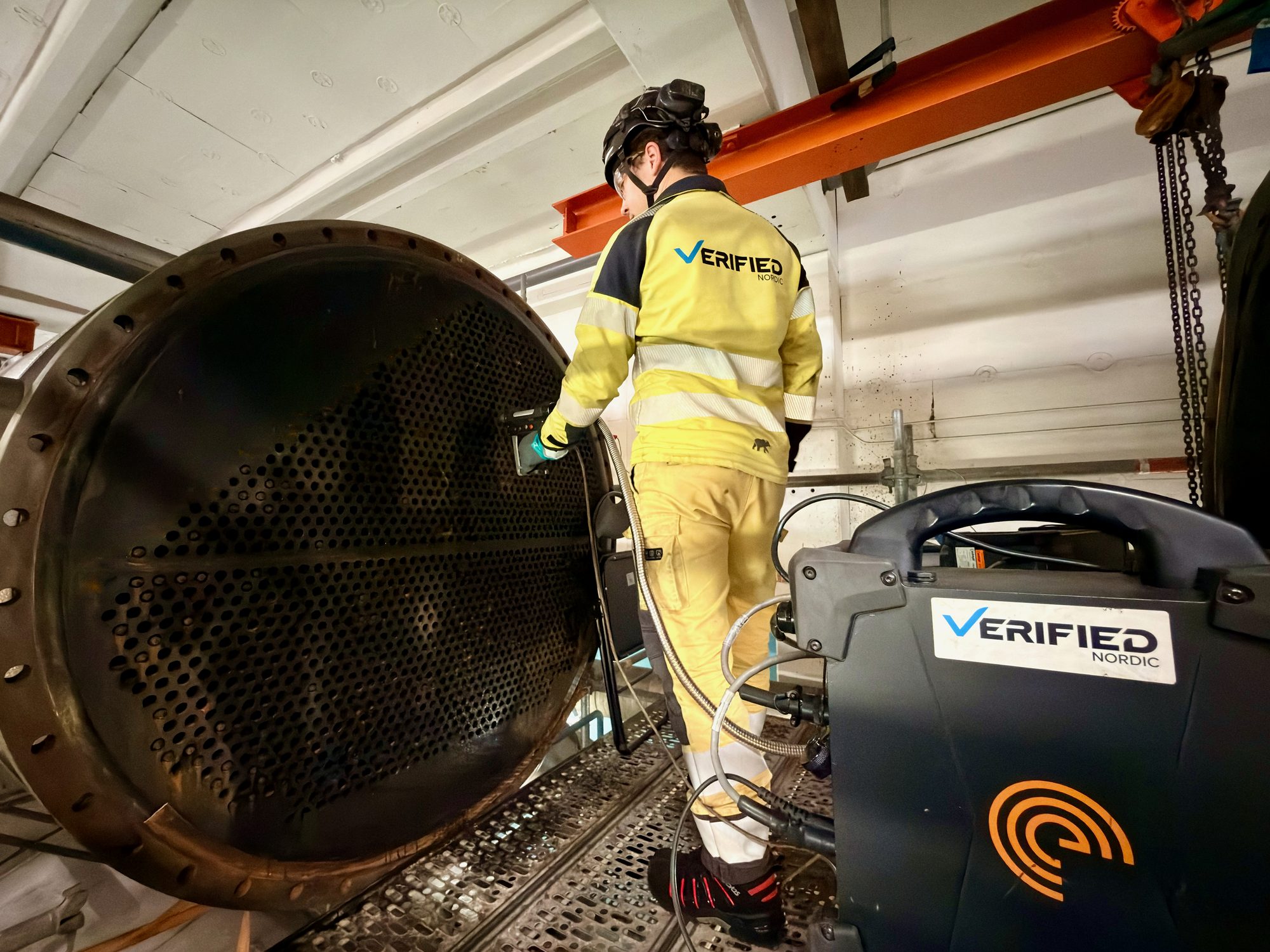
Tube testing
Eddy current and IRIS
Heat exchanger tubes can fail in many ways, and all of them can cause major downtime. Corrosion and erosion pit the wall and thin it until it can no longer hold pressure. Support plates wear grooves into the tubes through vibration. Deposits build up, choking flow and feeding corrosion underneath. Dents and deformation concentrate stress where the geometry changes. And cracks grow quietly until a tube lets go. The circumferential ones, especially near the tube sheet, are among the hardest to find.
No single technique covers all of it, so what we run depends on the tube itself, its material and dimensions, and the damage we expect. Non-magnetic bundles are tested with eddy current, bobbin probes for speed and array probes where it matters. Magnetic tubes take remote field or near field probes. IRIS ultrasound works on either, usually as verification, and measures the remaining wall in millimeters. Eddy current and ultrasonics complement each other very well.
Array probes are often the strongest tool in the kit. They hold high sensitivity to every defect type with their smaller coils, including the circumferential cracks a bobbin probe cannot see, and they stay accurate at the supports and the tube sheet where a bobbin loses its grip. We have the experience to run them well and to know when they are the right call.